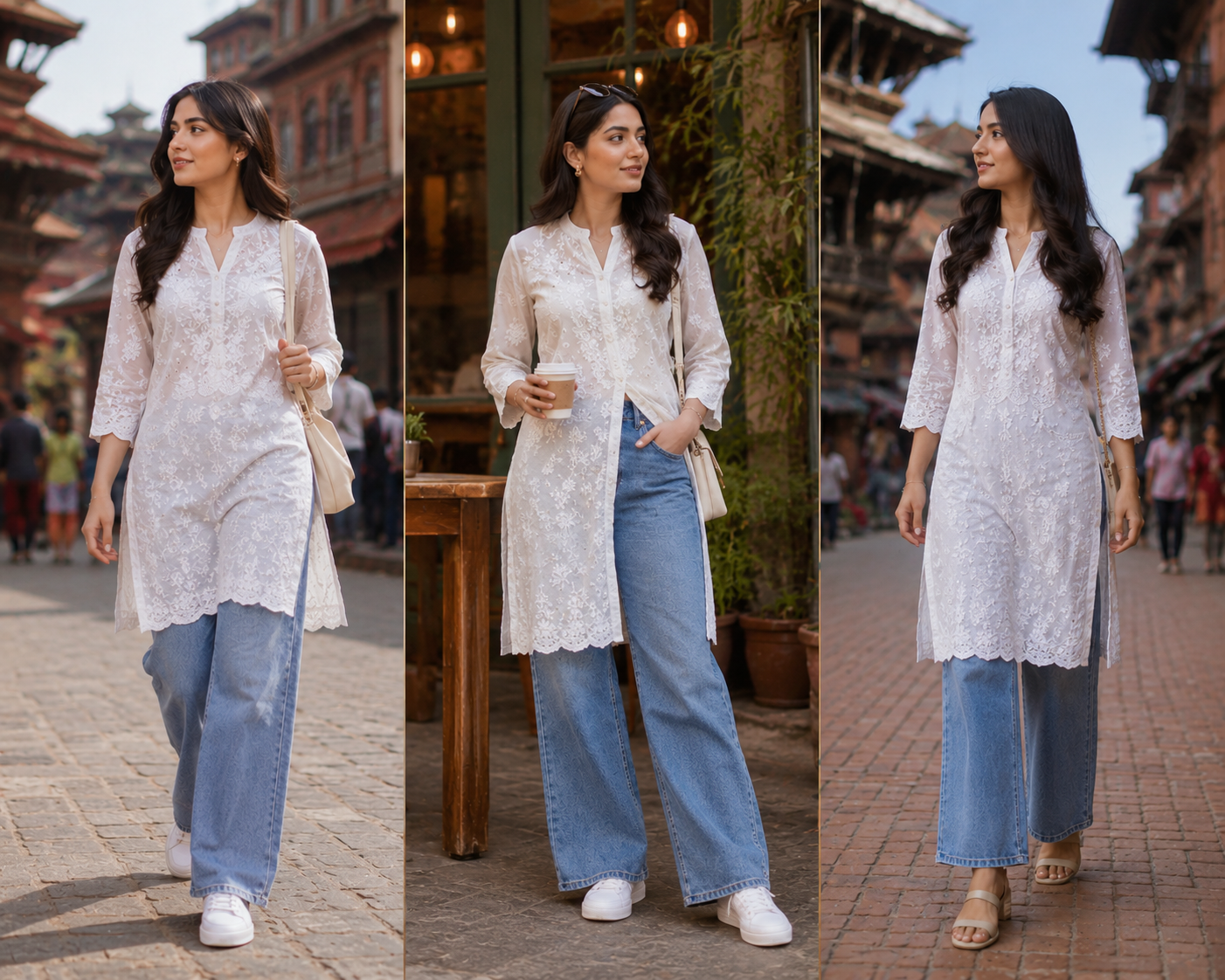
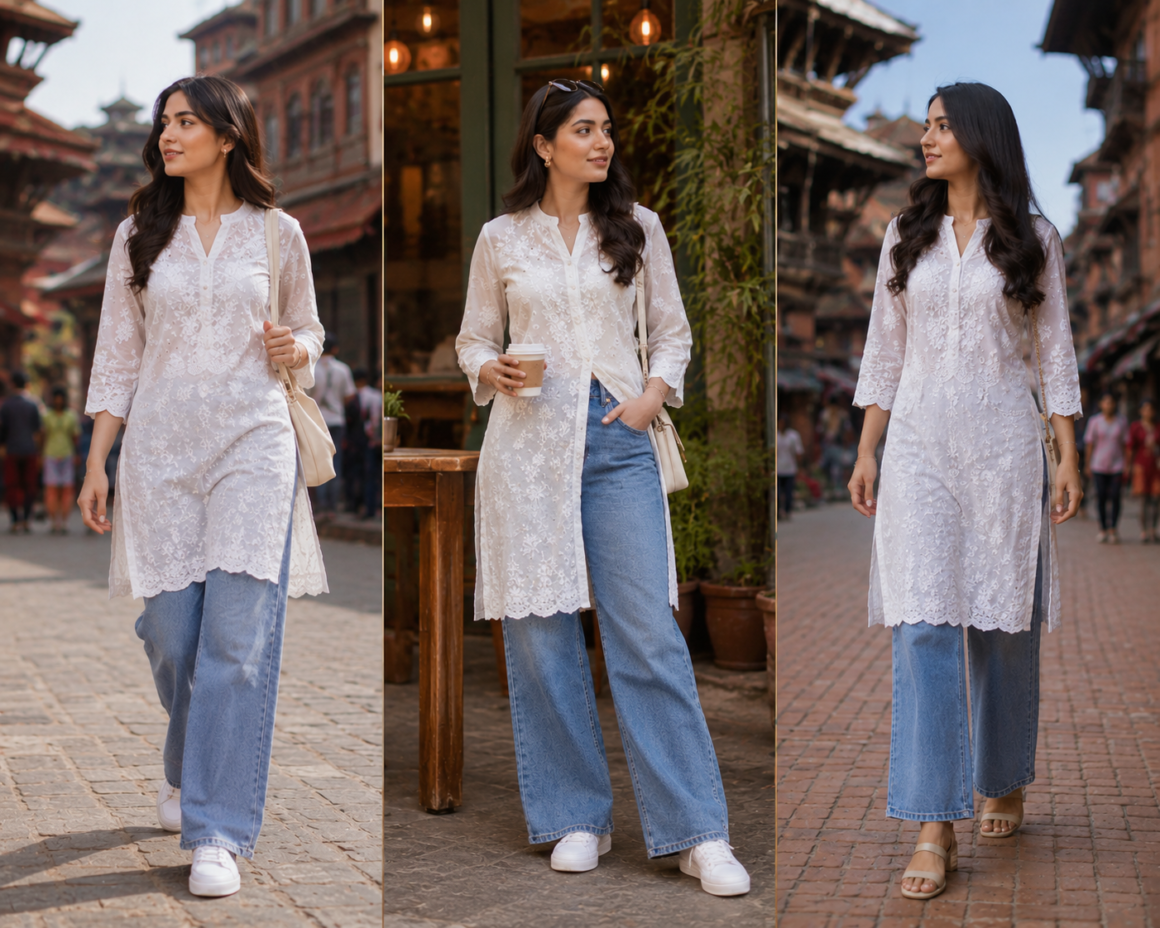
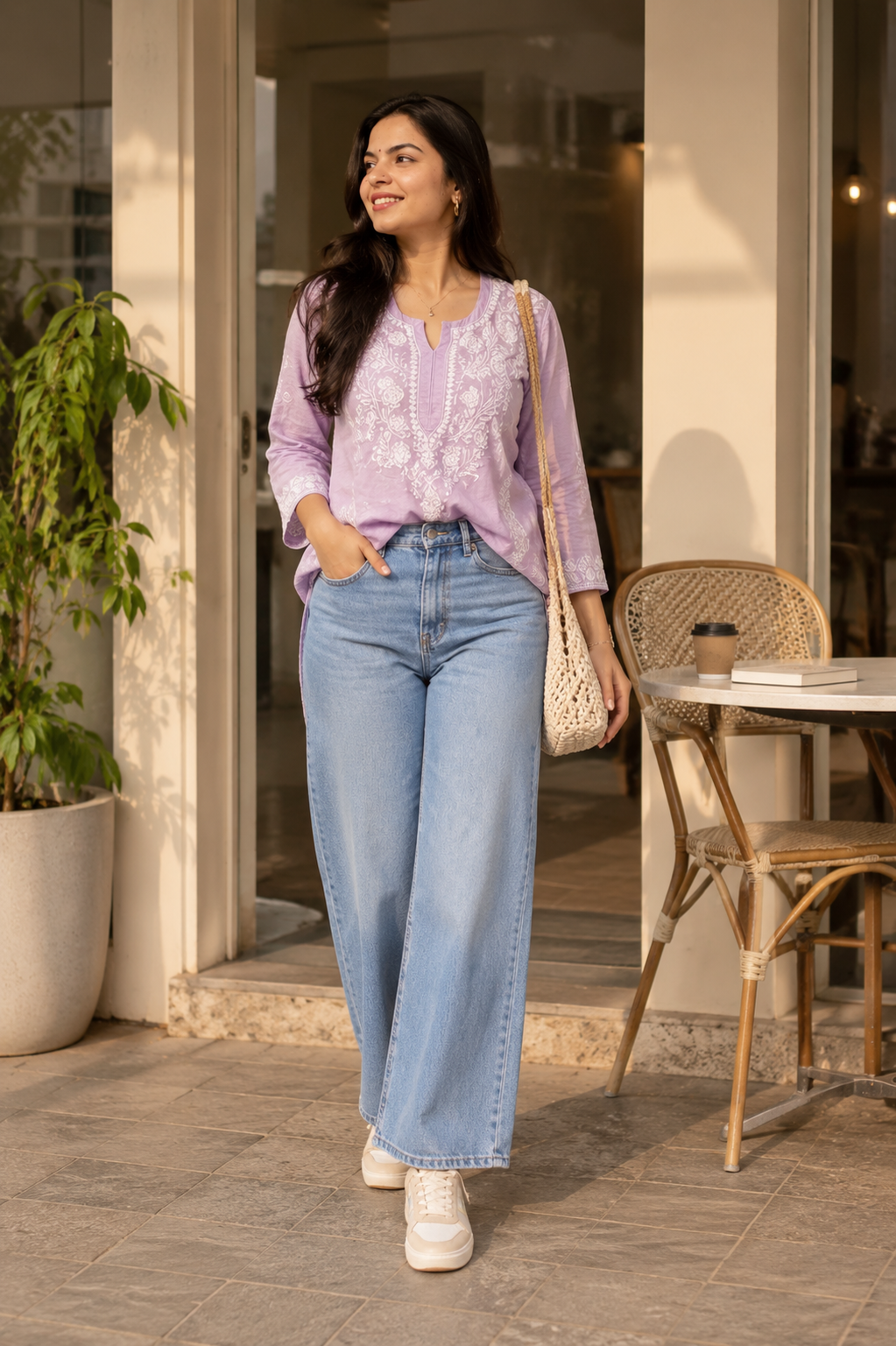
Step onto the bustling, cobblestone streets of New Road, navigate the vibrant alleyways of Jhamsikhel, or peek into the sunlit café corners of Lalitpur these days, and a definitive fashion formula immediately catches the eye. It is an ensemble that has quietly claimed the city: the delicate, sheer textures of a short Chikankari kurti paired seamlessly with structured, high-rise denim—locally and affectionately dubbed “belly jeans.”
What was once strictly relegated to the realm of traditional, occasion-based attire has undergone a remarkable metamorphosis, emerging as the city’s most effortless everyday uniform. Young urban women are enthusiastically championing this sartorial fusion. By balancing the soft, intricate artistry of ethnic embroidery with the rugged utility of contemporary denim, they have carved out a stylish, comfortable middle ground between cultural heritage and modern street fashion.
From Mughal Royalty to Kathmandu Streets
The historic roots of Chikankari embroidery trace back centuries to the opulent Mughal courts of Lucknow. Deeply influenced by Persian craftsmanship, this intricate shadow-work—traditionally executed with fine white thread on sheer cotton, chiffon, or premium muslin—is widely believed to have been popularized by Empress Noor Jahan in the 17th century. For generations, Chikankari was synonymous with aristocratic elegance, royal patronage, and meticulous luxury.
In Nepal, however, Chikankari long remained tethered to a more conservative aesthetic. For decades, it was primarily seen in the form of sweeping, knee-length kurtas reserved for religious festivals, formal family gatherings, or official functions. But fashion, by its very nature, refuses to remain static.
As global casual trends began to intersect with Nepal’s fast-evolving urban lifestyle, the traditional kurta underwent a quiet but radical evolution. Local designers and boutiques began experimenting with the silhouette, cropping the hemline into breezier, hip-length styles that felt inherently lighter, more youthful, and infinitely more adaptable. The exact moment these delicately embroidered tops collided with structured, high-waisted denim, a fresh Indo-Western street aesthetic was officially born.
Why the Combination Works
The true magic of this trend lies in the art of visual contrast. The fluid softness of lightweight cotton, georgette, or modal Chikankari provides a striking counterpoint to the rigid, utilitarian texture of denim. Furthermore, the modern short-cut kurti naturally complements the high-rise silhouette of the jeans, nipping in at the waist to create a visually elongated, clean, and flattering silhouette that suits diverse body types.
The styling of the outfit feels intentionally relaxed, avoiding the stiff perfection of formal wear. Hair is almost always left open—whether styled in soft, cascading curls, effortless beach waves, or sleek, straight textures that move with the city breeze. Unlike heavily accessorized traditional wear that demands statement jewelry, this modern uniform relies heavily on minimalism; a pair of simple silver hoops or a classic watch is usually all it takes to complete the look.
Footwear acts as the ultimate chameleon for this ensemble. Pairing the look with crisp white sneakers or chunky sports shoes makes it highly practical for navigating bumpy sidewalks, rushing to college lectures, commuting via local micro-buses, or spending hours café-hopping. However, swapping the flats for block heels or leather mules instantly elevates the entire aesthetic, making it polished enough for a dinner date or a casual evening business meeting.
A New Urban Identity
What makes this trend so fascinating is how authentically it mirrors Kathmandu’s evolving modern identity. It pays genuine homage to centuries-old South Asian craftsmanship without feeling restrictive, outdated, or overly formal. Simultaneously, the inclusion of denim keeps the aesthetic youthful, functional, and aligned with global street-style movements.
In many ways, this pairing serves as a visual metaphor for Nepal’s urban generation—a demographic deeply rooted in cultural appreciation but thoroughly shaped by contemporary, international influences.
By stripping away the perceived heaviness of traditional styling and grounding delicate, historical embroidery with everyday denim, Kathmandu’s fashion-forward crowd has created a signature street-style uniform. It is relaxed, highly photogenic, and unmistakably modern.